Target journals
Journals where the lab publishes and submits, by field. The list reflects the lab's actual publication and review record. See also the conferences page and the authorship policy.
Health, public health, and policy
Digital and mental health informatics
Social work
Migration, race, and ethnicity
Technology, AI, and computational social science
How publication works
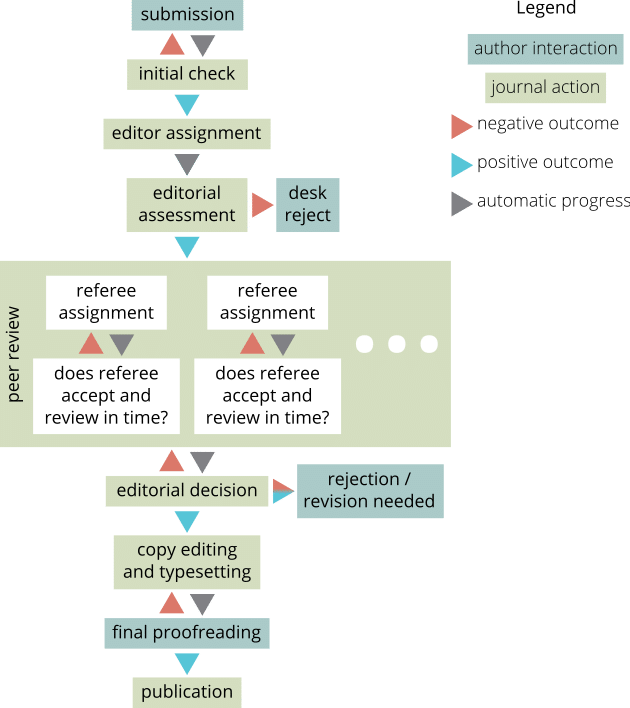
A peer-reviewed paper moves through a fixed sequence of steps. Knowing the workflow helps you read submission statuses and understand why publishing takes time. The figure below shows the typical journal process.
Submission and initial checks
After submission, staff run an initial check for formatting, scope, and completeness, and the handling editor screens the paper for fit. At the editorial assessment, the editor can desk reject the paper without sending it out for review. Submission volumes have grown steadily, with global research output rising by roughly 5 to 6 percent a year (Hanson et al., 2024), and because journals now receive far more papers than reviewers can absorb, editors lean on desk rejection to manage the load (editorial, 2015). For this reason, journal fit, a clear contribution, and a clean submission matter a great deal.
Peer review
If the paper passes, it enters peer review. The editor invites several referees, of whom only some agree, and those who accept read the manuscript and write evaluations. This stage is the slowest, often taking one to several months, and is why a paper can sit at "under review" for a long time. Reviewers comment on the contribution, methods, and clarity, and recommend a decision to the editor.
The decision
The editor weighs the reviews and decides: accept, revise and resubmit (minor or major revisions), or reject. Outright acceptance on the first round is rare. Most papers that are eventually published go through at least one round of major revision, so a revise-and-resubmit is a normal and encouraging result. Revisions are returned with a point-by-point letter that answers each reviewer comment, and a paper may go through more than one review round before a final decision.
Production and timelines
Once accepted, the paper moves into production: copy editing and typesetting, author proofreading of the typeset proofs, and then publication, often online first and later assigned to a volume and issue. End to end, the process commonly takes anywhere from about six months to two years or more, which is worth keeping in mind when planning submissions around deadlines.
For practical guidance on choosing a journal, avoiding desk rejection, suggesting reviewers, and responding to a rejection, see this guide: Tips for PhD students: writing, publication, and presentation.
Publications